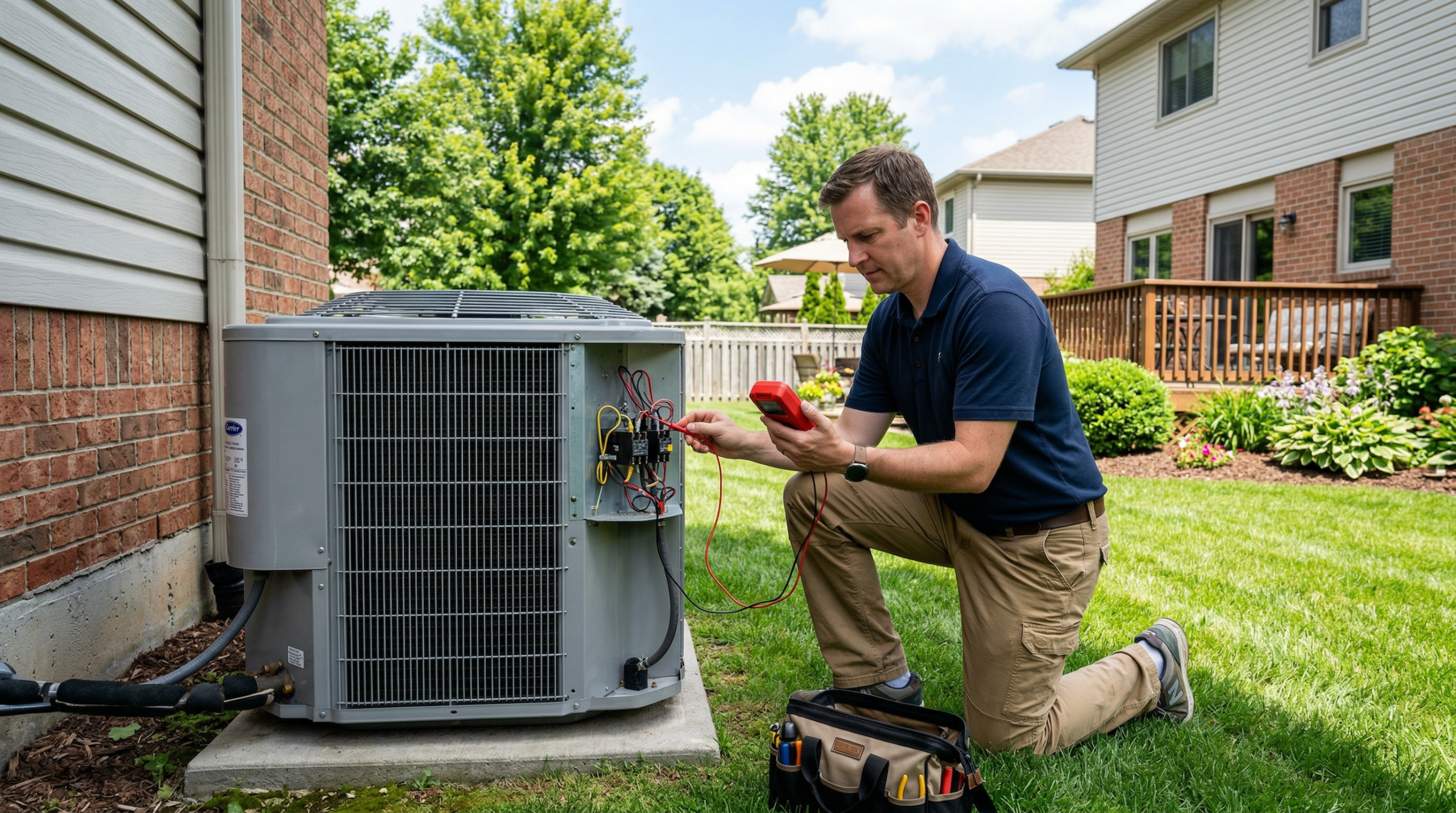
Quick Verdict: Most homeowners never need to call a technician for AC problems. In 20-plus years of maintaining my own central and window AC systems, I have traced 90% of failures back to 5 simple issues any homeowner fixes in under 30 minutes: a dirty filter, a tripped breaker, a thermostat set incorrectly, frozen evaporator coils, or a clogged drain line. When the problem goes deeper, professional AC repair costs $150–$650 on average, according to Modernize’s 2026 data. Work through this guide first and you stand a strong chance of solving the issue for under $30 in parts.
Last updated: April 2026 | 12 min read
In This Article
- Why Your Air Conditioner Stopped Working
- Key AC Repair Facts at a Glance
- How to Diagnose Your AC Problem
- Safety First: Before You Start Any AC Repair
- 10 DIY Air Conditioner Repairs to Fix the Problem Yourself
- AC Noise Diagnostics: What Each Sound Means
- How Much Do AC Repairs Cost? (DIY vs. Professional)
- Repair vs. Replace: When to Buy a New AC
- Pros and Cons of DIY AC Repair
- Final Verdict
- Frequently Asked Questions
Why Your Air Conditioner Stopped Working: How to Repair Air Conditioner Problems Yourself
Knowing how to repair an air conditioner is one of the most practical skills a homeowner builds, especially during the months when a broken system means days of miserable heat. The average American household runs its air conditioner for hundreds of hours each cooling season. Because of this heavy runtime, components wear, filters clog, and drainage lines back up. However, the majority of AC failures are entirely DIY-friendly, requiring no refrigerant certification and no special licenses.
This guide is written specifically for homeowners with central air systems and window units. Each repair section walks through the diagnosis, the fix, and the tools required. Before calling a technician, therefore, work through the 10 air conditioner repair steps below. For seasonal AC prep preventing most of these failures before they start, the spring home maintenance checklist also covers condenser cleaning, filter replacement, and thermostat calibration as part of a full annual audit.
Professional air conditioner repair is warranted for refrigerant leaks, compressor failures, and wiring faults. However, for everything beyond those three categories, the repairs below solve the problem at a fraction of the service call cost. Specifically, most fixes cost $0–$50 in parts and take between 15 and 45 minutes to complete.
Key AC Repair Facts at a Glance
| Fact | Data |
|---|---|
| Average professional AC repair cost | $150–$650 (Modernize, 2026) |
| Average DIY repair cost (parts only) | $0–$50 for most common fixes |
| Most common cause of AC failure | Dirty air filter restricting airflow |
| Time for most DIY repairs | 15–45 minutes |
| Recommended filter replacement interval | Every 1–3 months (monthly with pets) |
| Capacitor replacement: DIY vs. pro cost | $15–$50 DIY vs. $150–$400 professional |
| Tools needed for most repairs | Screwdrivers, multimeter, shop vac, garden hose |
| AC age threshold for replacement consideration | 12+ years (per Lennox repair vs. replace guidance) |
How to Diagnose Your AC Problem
Effective ac troubleshooting starts with matching your symptom to its most likely cause. Because systematic ac troubleshooting works through each possibility in order, it prevents the costly mistake of replacing parts unnecessarily. Consequently, the table below maps the 7 most common symptoms to their probable source and the air conditioner repair section covering the fix.
| Symptom | Most Likely Cause | DIY Fix Section |
|---|---|---|
| AC runs but no cold air | Dirty filter, frozen coils, low refrigerant | Repairs 1, 4, 7 |
| AC won’t turn on | Tripped breaker, thermostat fault, failed capacitor | Repairs 2, 3, 9 |
| AC short cycles (turns on and off rapidly) | Dirty filter, thermostat error, oversized unit | Repairs 1, 3 |
| Water leaking inside | Clogged condensate drain, frozen coils thawing | Repairs 4, 5 |
| AC making loud noise | Loose panel, debris, failing capacitor, compressor | Noise Diagnostics section |
| Uneven cooling room to room | Duct leak, blocked vents, undersized unit | Repairs 6, 8 |
| AC runs constantly without reaching set temp | Low refrigerant, dirty condenser, undersized unit | Repair 6; call pro for refrigerant |
Safety First: Before You Start Any AC Repair
No air conditioner repair starts without powering the system down completely. Whether you repair an air conditioner yourself or watch a technician do it, every service begins with the same power-down sequence. Notably, central AC systems carry 240V at the outdoor disconnect and at the main panel breaker. Skipping this step is how homeowners get seriously hurt, so follow these steps in order before touching any component.
- First, set your thermostat to OFF, not simply to a high temperature.
- Next, locate the outdoor disconnect box mounted on the wall near the condenser unit. Open the cover and pull the disconnect block out or flip it to OFF.
- Then go to your main electrical panel. Flip the breaker labeled “AC,” “Air Handler,” or “Furnace” to OFF. Because central systems often use two separate breakers, one for the outdoor compressor and one for the indoor air handler, flip both.
- After flipping both breakers, wait 5 full minutes before opening any access panel on the outdoor unit. Capacitors store a charge even after power is removed, so the wait lets them discharge passively.
- Finally, gather your tools: flathead and Phillips screwdrivers, a multimeter, needle-nose pliers, a shop vac, a garden hose, and coil cleaner spray (Nu-Calgon Evap Foam works well for both indoor and outdoor coils).
For capacitor replacement specifically, also use a resistor to discharge the capacitor manually before touching any terminals. Additionally, the electrical safety risks in AC work parallel other household wiring projects. The guide on common DIY electrical mistakes likewise covers the grounding and circuit safety principles applying directly to air conditioner repair work.
10 DIY Air Conditioner Repairs to Fix the Problem Yourself
Each section below shows how to repair air conditioner issues using standard tools and basic mechanical skills. However, if the diagnostic table above pointed you directly to a specific repair, skip ahead to the relevant step instead of working through each one in order.
1. Replace a Dirty Air Filter
A clogged air filter is the single most common cause of ac not blowing cold air. In fact, restricted airflow from a neglected filter accounts for roughly 50% of all residential AC service calls, according to Angi’s troubleshooting data. Because restricted airflow forces the system to run longer and work harder, it starves the evaporator coil of the air it needs to transfer heat. Consequently, in severe cases the coil freezes solid and the system stops cooling entirely.
To replace it, first locate your filter slot at the return air vent or at the air handler itself. Then pull the old filter and hold it up to a light source. If you see no light through it, replace it immediately. Filters are sized by length, width, and thickness printed on the frame, including standard sizes such as 16x20x1 and 20x25x1. A new 1-inch fiberglass filter costs $2–$5; by comparison, a quality pleated filter costs $10–$25 and lasts 3 months under normal use, or 1 month in a home with pets. After installation, confirm the arrow on the filter frame points toward the air handler, indicating correct airflow direction.

2. Reset a Tripped Circuit Breaker
When an AC system loses power completely, the circuit breaker is often the culprit. To check, go to your electrical panel and look for a breaker in the tripped position, typically sitting between ON and OFF or visually offset from the other breakers.
First, push the breaker fully to OFF, then firmly back to ON. Next, wait 30 seconds before switching the thermostat back to COOL. If the breaker trips again within minutes, however, stop and call an electrician. Because a repeatedly tripping breaker signals a wiring fault, a failing compressor, or an overloaded circuit, all three worsen without professional attention.
3. Check and Recalibrate the Thermostat
A notable share of AC service calls trace back to thermostat problems, based on HVAC technician experience. To start, replace the batteries. Next, set the fan to AUTO rather than ON. Because a fan set to ON blows air continuously, including uncooled air between compressor cycles, it creates the impression of warm air at the vents.
Then set the target temperature at least 5°F below the current room temperature and wait 5 minutes for the compressor to cycle on. If the thermostat display is blank or unresponsive after fresh batteries, however, the device needs replacement. A basic programmable thermostat runs $20–$50; by comparison, a smart thermostat runs $100–$250 and often pays for itself through energy savings within a year.
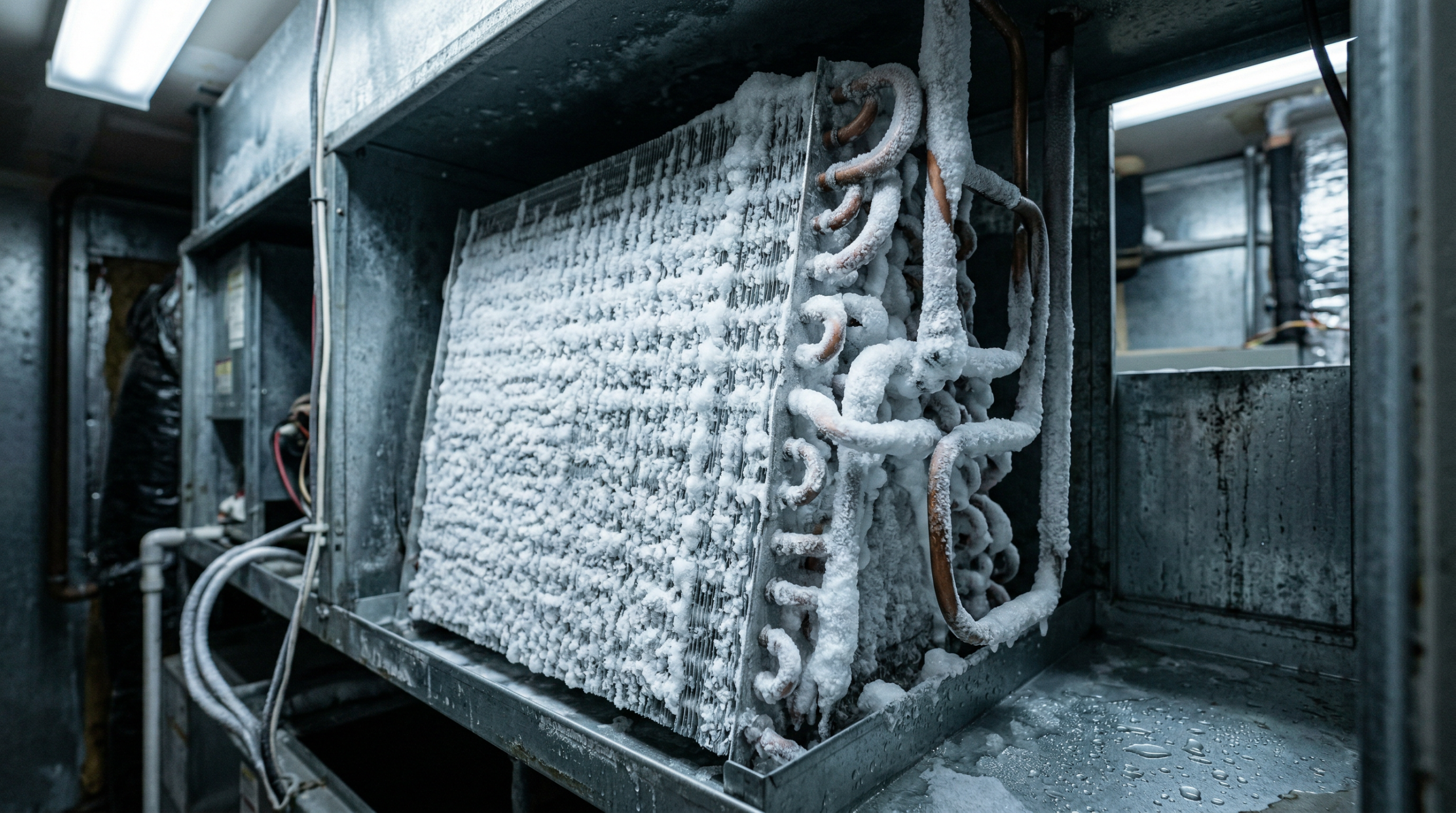
4. Defrost Frozen Evaporator Coils
Ice on the copper refrigerant lines running to your indoor unit, or visible frost on the air handler access panel, indicates frozen evaporator coils. Because a frozen coil blocks airflow entirely, this explains why ac not blowing cold air sometimes produces no airflow at all.
To fix this, switch the system to FAN ONLY mode and leave it running for 2–4 hours. The fan then circulates warm room air across the coil and melts the ice. Also place towels around the air handler to catch drip water. After defrosting, identify the root cause before switching back to COOL, because a dirty filter causes roughly 80% of frozen coil events. Low refrigerant causes most of the remaining 20% and consequently requires a licensed technician to diagnose and recharge.
5. Clear a Clogged Condensate Drain Line
The condensate drain line carries moisture pulled from indoor air to a floor drain or outdoors. Over a cooling season, however, algae and debris build up inside the PVC pipe and create a clog. As a result, water backs up into the drain pan, overflows, and leaks inside the house.
First, locate the condensate drain line access point, typically a capped T-fitting on the white PVC pipe near the indoor air handler. Then remove the cap, pour 1 cup of distilled white vinegar into the line, and let it sit for 30 minutes. Next, follow with a shop vac held firmly against the outdoor end of the drain line for 60 seconds. The suction dislodges the blockage immediately in most cases. Finally, flush once monthly with vinegar during the cooling season to prevent recurrence.
6. Clean the Outdoor Condenser Unit
The outdoor condenser unit rejects heat from the refrigerant to the outside air. When airflow through the condenser fins drops, therefore, the entire system works harder to achieve the same cooling output. Specifically, when fins and coils are packed with grass clippings, cottonwood fluff, or leaves, the unit transfers heat inefficiently. As a result, the compressor runs hotter, uses more energy, and fails years ahead of schedule.
With power off at the outdoor disconnect, first clear all vegetation and debris from a 2-foot perimeter around the unit. Next, remove the top grille or fan cover (usually held by 4–6 screws) and vacuum debris from inside. Then spray the fins with a garden hose from the inside out at moderate pressure to push dirt outward rather than deeper into the coil. Also straighten bent fins with a fin comb, available for $10–$15 at hardware stores. According to the U.S. Department of Energy, a severely dirty condenser increases energy consumption by up to 15%.
7. Clean Evaporator Coils (Indoor Unit)
Indoor evaporator coils accumulate dust and mold over time, especially when filters go unchanged for months. Consequently, dirty coils reduce heat transfer efficiency and produce musty odors at every vent in the house.
With the system powered down, first remove the access panel from the indoor air handler (usually 2–4 screws). Then spray Nu-Calgon Evap Foam No-Rinse Coil Cleaner directly onto the coil surface. The foam expands, lifts contaminants, and drains into the condensate pan below without rinsing. While the coil dries, also clean the condensate drip pan with a diluted bleach solution (1 tablespoon bleach per 1 gallon of water) to kill algae growth. Finally, reattach the access panel, restore power, and check for improved airflow within 10 minutes.
8. Inspect and Clean Air Ducts and Vents
Uneven cooling across rooms often points to duct problems rather than system failures. Before scheduling a service call, however, walk every room and rule out the two simplest causes first. Specifically, confirm every supply and return vent is fully open and unobstructed by furniture or rugs. Because a single closed vent in a room creates backpressure across the system, it also reduces overall efficiency.
Next, visually inspect accessible duct runs in attics, crawlspaces, and unfinished basements. Disconnected duct sections, visible in about 15% of homes per industry estimates, lose conditioned air directly into unconditioned spaces. Re-sealing separated joints with foil-backed HVAC tape (not standard duct tape, which fails in heat) costs under $20 in materials and consequently recovers significant lost cooling capacity. By comparison, a complete duct cleaning by a professional costs $300–$500 and is worth scheduling every 5–7 years. While inspecting these areas, also look for signs of water intrusion — a roof leak left unchecked introduces moisture that degrades duct insulation and promotes mold growth around HVAC components.
9. Replace an AC Capacitor
The capacitor is the component starting and running the compressor and fan motors. When it fails, the system hums but won’t start, or the outdoor fan spins slowly in the wrong direction. Notably, this single $15–$50 part accounts for a large share of mid-summer emergency air conditioner repair calls. HVAC companies charge $150–$400 to replace a capacitor, while the part itself costs $15–$50 at any HVAC supply house or online retailer. Because of this price gap, capacitor replacement is the highest-value DIY repair in the list.
After powering down and waiting 5 minutes, open the outdoor condenser side panel (typically 4 screws). Inside, the capacitor is a cylindrical metal component with 2–3 wire terminals. Before touching it, however, discharge any remaining charge by bridging the terminals with the shaft of an insulated screwdriver, or alternatively use a 20,000-ohm, 5-watt resistor connected across each terminal pair.
First, photograph the existing wire connections before removing anything. Then match the replacement capacitor to the original by rating, because both the microfarad (µF) value and the voltage must match. Common µF ratings printed on the capacitor label include 35µF, 45µF, and 60µF. Your replacement voltage must also meet or exceed the original. After transferring each wire to the identical terminal on the new capacitor, restore power and test. In my experience, a capacitor swap fixes the problem immediately in roughly 80% of cases where the AC hums but doesn’t start.

10. Clean a Window AC Unit
Window ac repair gets overlooked in most guides, yet window units share the same core failure modes as central systems. Treating window ac repair with the same rigor as central system troubleshooting, therefore, resolves most problems in under 20 minutes. For example, a dirty filter in a window unit restricts airflow exactly as it does in central AC. Most window unit filters pull out from the front grille, wash in warm soapy water, dry completely, and slide back in. Clean the filter monthly during heavy use.
Beyond the filter, also remove the unit from the window once per season (or in place if weight prevents removal) and spray the condenser coils on the exterior side with a coil cleaner. Next, check the drain ports at the base of the unit exterior. Because a clogged drain port causes water to pool inside the unit and drip indoors, compressed air or a thin wire clears blocked ports in seconds. Finally, reseal the foam weatherstripping around the unit if gaps have developed, since air bypassing the unit from outside reduces cooling efficiency and adds humidity load.
AC Noise Diagnostics: What Each Sound Means
Identifying the source of an unusual AC sound narrows the diagnosis faster than any other method. Because different sounds indicate completely different failure modes, the table below separates DIY-fixable issues from problems requiring professional service.
| Sound | Likely Cause | DIY or Pro? |
|---|---|---|
| Buzzing / electrical hum | Failing capacitor, contactor relay, loose wiring | DIY for capacitor; Pro for relay/wiring |
| Rattling | Loose access panel, debris caught in fan blades | DIY |
| Hissing | Refrigerant leak at line connection or coil | Pro only (EPA-regulated) |
| Banging / clanking | Broken fan blade, loose compressor mount | Pro |
| Clicking at startup | Normal relay operation; continuous clicking = relay fault | Normal / Pro for continuous |
| Squealing / screeching | Fan motor bearing failure, worn belt (older units) | DIY belt replacement; Pro for motor |
A buzzing sound paired with the system humming but not starting almost always points to a failed capacitor; Repair 9 above covers the full step-by-step process. In contrast, a hissing sound combined with ice on the refrigerant lines confirms a refrigerant leak, which requires an EPA Section 608-certified technician. Attempting to handle refrigerant without certification is a federal violation with fines exceeding $57,000 per day under current EPA enforcement guidelines.
How Much Do AC Repairs Cost? (DIY vs. Professional)
Professional AC repair costs $150–$650 on average, with the service call fee alone running $75–$150 before any parts, according to Modernize’s 2026 cost data. Knowing how to repair air conditioner problems yourself, however, eliminates the service call fee entirely on the most common failures. Consequently, the table below shows the DIY cost for parts versus the professional rate for the same repair. For instance, savings on capacitor replacement alone often justify the time invested in learning this guide.
| Repair Type | DIY Cost (Parts) | Pro Cost (Parts + Labor) |
|---|---|---|
| Air filter replacement | $5–$25 | $75–$150 (service call only) |
| Capacitor replacement | $15–$50 | $150–$400 |
| Thermostat replacement | $20–$150 | $100–$300 |
| Condensate drain clearing | $0–$15 | $75–$200 |
| Coil cleaning (indoor + outdoor) | $10–$30 | $100–$400 |
| Refrigerant recharge | Not legal without EPA certification | $200–$500 |
| Fan motor replacement | $50–$150 (advanced DIY) | $300–$700 |
| Compressor replacement | Not recommended for DIY | $900–$2,900 |
Beyond the table numbers, the compressor replacement figure especially deserves attention. At $900–$2,900 in labor and parts, a compressor replacement on a unit older than 10 years often triggers the replacement calculation in the next section. By comparison, small repairs add up predictably: a filter, a capacitor, and annual coil cleaning cost under $100 total when handled yourself each season.
Repair vs. Replace: When to Buy a New AC
The decision to repair or replace a central AC unit comes down to three straightforward rules. Apply each one in sequence before authorizing any expensive air conditioner repair. Because the approach is systematic, it takes under five minutes to work through.
First, apply the 5000 Rule from Lennox’s repair vs. replace guidance: multiply the unit’s age in years by the estimated repair cost. If the result exceeds $5,000, replacement is the better financial decision. A 12-year-old unit facing a $450 repair equals $5,400, which edges past the threshold.
Second, use the 50% Rule: if the repair cost exceeds 50% of the price of a comparable new unit, replace. A new 3-ton central AC system costs $5,000–$12,000 installed. For an aging unit, a repair bill of $3,000 or more crosses the 50% line.
Third, consider age thresholds on their own. Units under 8 years old almost always warrant repair. Systems between 8 and 12 years old require the 5000 Rule calculation. Anything older than 12 years leans strongly toward replacement, particularly if they use R-22 refrigerant. R-22 was phased out in 2020 and now costs $90–$250 per pound on the remaining supply, compared to $12–$75 for R-410A. A single recharge of an R-22 unit runs $600–$1,500, and the next recharge is guaranteed.
For broader context on how AC replacement costs compare to other major home improvement decisions, the home improvement cost guide similarly shows how to evaluate large expenditures against home value and expected return.
Pros and Cons of DIY AC Repair
Pros
- Saves $75–$350 in service call and labor fees on most common repairs
- Capacitor replacement costs $15–$50 vs. $150–$400 professionally
- Most fixes complete in 15–45 minutes without waiting for a technician
- Builds system familiarity and prevents future failures through better maintenance
- Filter and drain maintenance costs under $30/year and prevents 80%+ of breakdowns
- Coil cleaning DIY ($10–$30) vs. professional ($100–$400)
Cons
- Capacitor and electrical work carry genuine shock risk without proper discharge steps
- Refrigerant handling is federally illegal without an EPA Section 608 certification
- DIY repairs on systems under warranty risk voiding manufacturer coverage
- Compressor and fan motor replacement require skills beyond typical DIY comfort
- Misdiagnosis wastes money on wrong parts before the real fix is identified
Final Verdict
Homeowners willing to follow a clear process save hundreds of dollars each cooling season by learning how to repair an air conditioner at this level. In fact, the investment takes a single afternoon and pays back on the first repair. The 10 repairs in this guide cover the overwhelming majority of AC failures without requiring special licenses or expensive tools. Specifically, a dirty filter, a tripped breaker, a thermostat fault, frozen coils, a clogged drain line, and a failed capacitor account for the vast majority of service calls technicians make each summer.
However, repairs requiring a professional are specific and non-negotiable: refrigerant work, compressor replacement, repeated breaker trips indicating a wiring fault, and any repair involving the main electrical service. These are not minor edge cases. Instead, they involve federal regulation, high-voltage electrical systems, or mechanical complexity making professional service the only rational choice.
From a cost standpoint, the math is clear. For example, replacing a capacitor yourself costs $15–$50, while the same air conditioner repair billed by an HVAC company costs $150–$400. Similarly, a full DIY maintenance routine covering filter changes, annual coil cleaning, drain line flushing, and condenser clearance runs under $50 per year and prevents 80% of the failures driving service calls. Compared to the average professional repair at $150–$650, the return on a few hours of seasonal attention is substantial.
For units older than 12 years or systems using R-22 refrigerant, therefore, run the 5000 Rule calculation before authorizing any repair over $300. Replacement often makes more financial sense than continued repair on aging equipment, especially once cooling efficiency drops and energy bills climb. Work through the 10 repairs here first, then make the replacement decision from an informed position.
Frequently Asked Questions
Why is my AC running but not cooling the house?
When you need to repair an air conditioner, the most common causes of poor cooling are a dirty air filter blocking airflow, frozen evaporator coils from sustained restricted airflow, or a dirty outdoor condenser unit transferring heat inefficiently. Start by replacing the filter and inspecting the refrigerant lines for ice. If the lines are frosted, switch to fan-only mode for 2–4 hours to defrost before resuming cooling. Low refrigerant is also a cause, but requires a licensed technician to diagnose and recharge.
How do I reset my air conditioner?
Most central AC systems reset by switching the thermostat to OFF, waiting 5 minutes, then switching back to COOL. If the system tripped a circuit breaker, push the breaker fully to OFF and then back to ON before returning the thermostat to COOL. Some systems include a dedicated reset button on the outdoor compressor unit, typically a small red button behind the access panel. Press and hold it for 3–5 seconds.
How often should I replace my AC filter?
Standard 1-inch filters need replacement every 30–90 days depending on household conditions. Homes with pets or allergy sufferers benefit from monthly replacement. Thicker 4–5 inch media filters last 6–12 months between changes. Write the installation date on the filter frame and set a phone reminder. A clogged filter is the single most preventable cause of ac not blowing cold air and early system failure.
Is it legal to add refrigerant to my AC myself?
No. The EPA’s Section 608 regulations prohibit purchasing or handling refrigerants above a de minimis quantity without EPA certification. This applies to both R-22 (phased out in 2020) and the current R-410A standard. Violations carry civil penalties exceeding $57,000 per day under current inflation-adjusted EPA guidelines. Schedule a licensed HVAC technician for any refrigerant diagnosis or recharge. The technician also identifies the leak responsible for the refrigerant loss.
What does it mean when my AC is making a loud noise?
The sound type identifies the cause. Buzzing or an electrical hum with no start typically indicates a failed capacitor, a DIY repair covered in this guide. Rattling points to a loose access panel or debris inside the fan housing. Hissing signals a refrigerant leak and requires immediate professional service. Banging or clanking indicates a broken fan blade or loose compressor mount. Switch the system off immediately if you hear banging to prevent further mechanical damage.
Is it worth repairing an AC unit at the 10-year mark?
Apply the 5000 Rule: multiply 10 years by the repair estimate. A $400 repair on a 10-year-old unit yields $4,000, below the $5,000 threshold. In this case, repair makes sense. At 12 years with the same $400 repair, the result is $4,800, still below $5,000 but approaching the threshold. Also check the refrigerant type. Units manufactured before 2010 often use R-22, now unavailable as a new production refrigerant and expensive on the remaining supply. R-22 systems warrant replacement regardless of the 5000 Rule result.
Leave a Reply