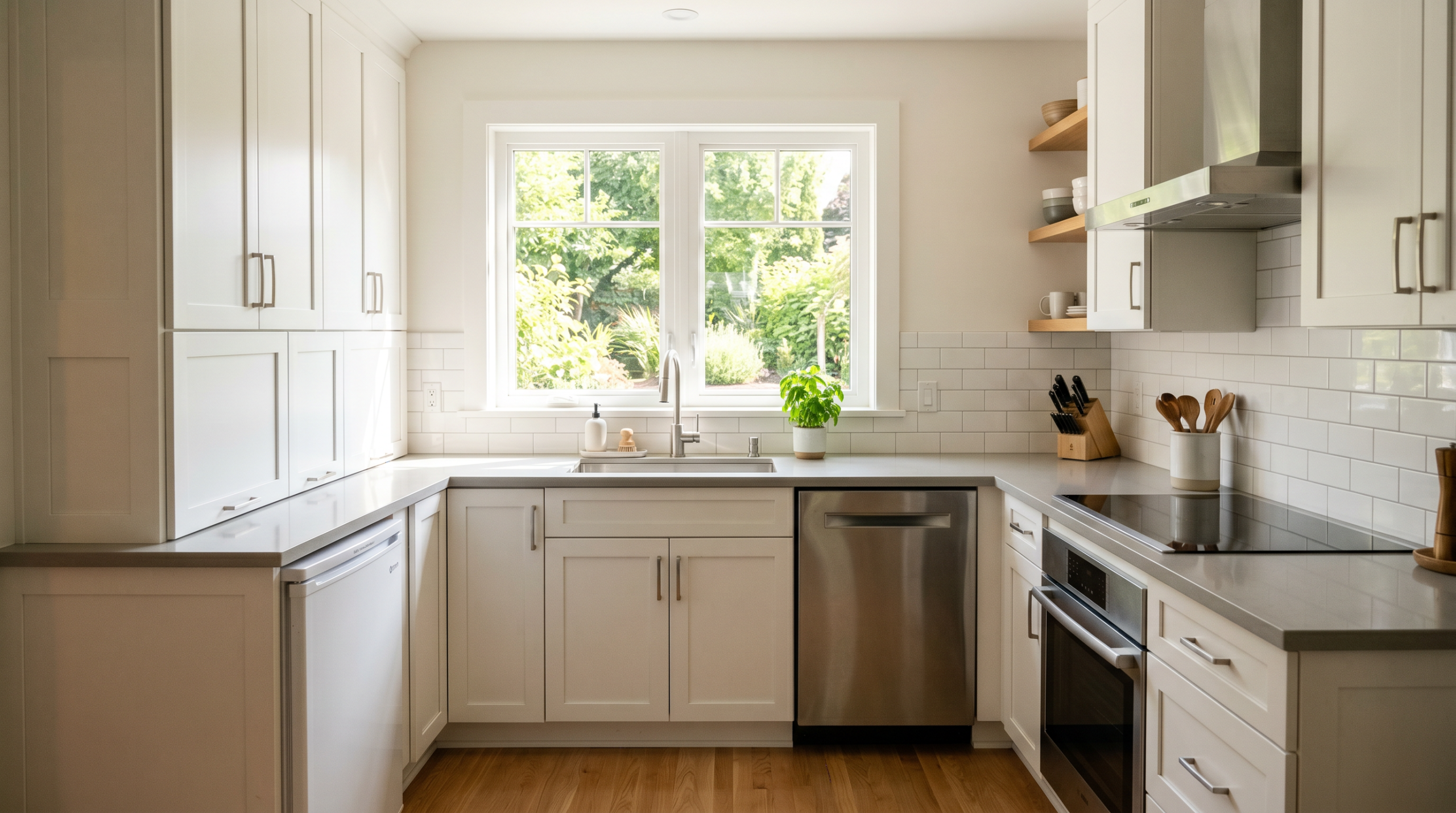
Quick Verdict: The best paint colors for small kitchen walls and cabinets share one feature: high Light Reflectance Value (LRV). Warm whites like Benjamin Moore White Dove (OC-17, LRV 83) and Sherwin-Williams Alabaster (SW 7008, LRV 82) top the list because they bounce light around tight spaces without feeling clinical. For color beyond white, muted blue-greens like SW Sea Salt (LRV 63) and BM Palladian Blue (LRV 60) add personality while keeping the room airy. Pair satin finish on walls with semi-gloss on cabinets for the strongest durability and light reflection.
Last updated: April 2026 | 10 min read
In This Guide
Why Paint Color Matters in a Small Kitchen
I’ve painted four kitchens over the years: light yellow in one, soft blue in another, whitish olive green, and even a bold dark red. Each lighter shade made the space feel open and energizing. The dark red? It lasted only a few months before I repainted it light green because the room felt noticeably smaller every time I walked in. Those four projects taught me firsthand: the best paint colors for small kitchen spaces are light, warm, and reflective.
Color affects how large a room feels because lighter shades reflect more light, while darker tones absorb it. Since counters, appliances, and cabinets already compete for visual attention in a small kitchen, wall color is the largest single surface you control. Choosing the right paint colors for small kitchens means selecting shades with high Light Reflectance Values (LRV), the metric measuring how much light a color bounces back into the room on a scale of 0 to 100.
This guide covers 10 specific paint colors from Benjamin Moore and Sherwin-Williams, each with the exact color code, LRV number, and recommended surface. In addition, you will find finish recommendations by surface and a cabinet strategy section, two topics most small kitchen paint ideas articles skip entirely.
10 Best Paint Colors for Small Kitchen Spaces
The table below lists all 10 colors from highest to lowest LRV, with codes and recommended surfaces. For reference, colors above LRV 80 work on every surface in any kitchen size. In contrast, colors between 60 and 70 need adequate natural light to avoid making a small space feel dim.
| Color | Code | LRV | Category | Best Surface |
|---|---|---|---|---|
| BM Chantilly Lace | OC-65 | 90.04 | Crisp white | Walls + cabinets + trim |
| BM Simply White | OC-117 | 89.5 | Bright warm white | Walls + upper cabinets |
| SW Pure White | SW 7005 | 84 | Neutral soft white | Walls + cabinets + trim |
| BM White Dove | OC-17 | 83.16 | Soft warm white | Cabinets + walls |
| SW Alabaster | SW 7008 | 82 | Creamy off-white | Walls + cabinets |
| BM Pale Oak | OC-20 | 68.64 | Warm greige | Walls (well-lit kitchens) |
| BM Gray Owl | OC-52 | 64.51 | Warm light gray | Walls |
| SW Sea Salt | SW 6204 | 63 | Soft green-gray | Walls |
| BM Palladian Blue | HC-144 | 60.4 | Muted blue-green | Walls |
| SW Evergreen Fog | SW 9130 | 30 | Muted sage green | Cabinets (two-tone) |
LRV (Light Reflectance Value) measures how much light a paint color reflects on a 0 to 100 scale. Pure black = 0, pure white = 100. For small kitchen walls, aim for LRV 70 or higher. On cabinets, LRV 80 or higher gives the strongest space-expanding effect.
Whites and Off-Whites for Small Kitchens
White remains the most effective wall color for making a small kitchen feel larger because it delivers the highest LRV range (82 to 90+). However, the wrong white leads to a cold, sterile atmosphere. The key is selecting whites with warm undertones, since they reflect light without creating a clinical feel.
Benjamin Moore Chantilly Lace (OC-65)
Chantilly Lace tops BM’s white lineup with an LRV of 90.04, the highest on this list. It reads as a clean true white without leaning yellow or blue, making it ideal for a monochromatic kitchen where walls, cabinets, and trim all share the same shade. Notably, it works especially well in kitchens with limited natural light because its near-maximum reflectivity compensates for fewer windows.
Benjamin Moore Simply White (OC-117)
Simply White carries an LRV of 89.5 with a subtle warm yellow undertone. Because of this warmth, it avoids the “hospital” look homeowners often fear from white kitchens. Benjamin Moore lists it among their most popular kitchen colors, and it pairs well as a trim color alongside slightly deeper wall shades like Pale Oak or Gray Owl.
Sherwin-Williams Pure White (SW 7005)
At LRV 84, Pure White sits between warm creams and crisp whites. Because it adapts to natural light throughout the day, reading cooler in the morning and warmer by evening, designers often call it a “chameleon” white. As a result, it works well in small kitchens with east-facing windows, where the room needs a shade stable enough to look good from sunrise to sunset.
Benjamin Moore White Dove (OC-17)
White Dove (LRV 83.16) is one of BM’s best-selling whites for a clear reason: its subtle yellow-cream warmth makes cabinets feel inviting rather than harsh. In addition, a satin finish on White Dove cabinets reflects enough light to brighten the room while resisting kitchen grease and moisture. I used a similar warm white on my own kitchen cabinets after testing several options, and the difference in how spacious the room felt was immediate.
Sherwin-Williams Alabaster (SW 7008)
Alabaster delivers warmth at LRV 82 with a slightly creamier, more golden character than White Dove. Designers and homeowners consistently choose it for small kitchens because the golden undertone counteracts the cool, flat light common in tight spaces. Because north-facing kitchens receive cooler natural light, the extra warmth Alabaster provides makes it especially effective in those rooms.
Warm Neutrals, Blues, and Greens
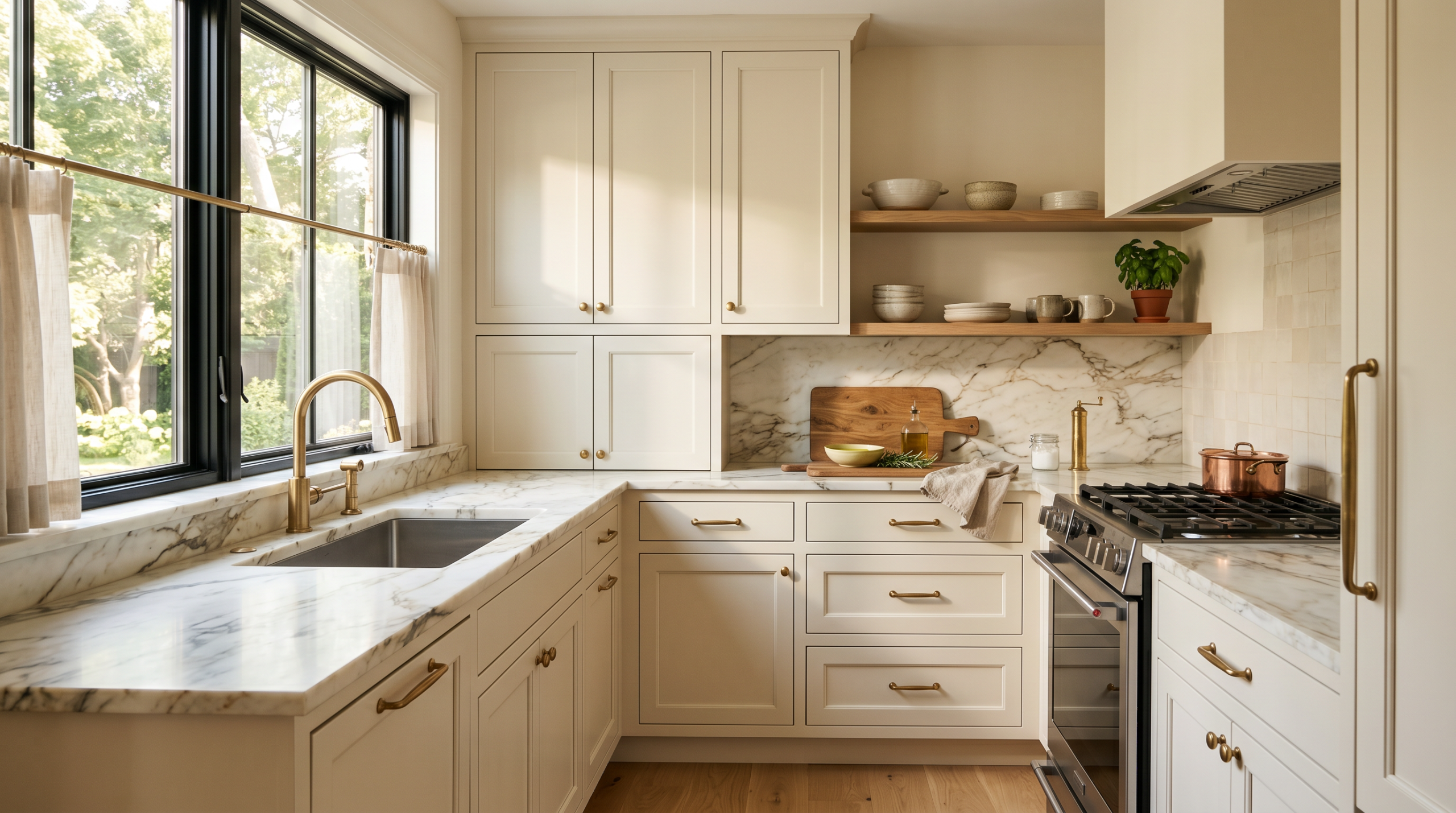
White is the safest choice for maximizing space, yet it is not the only option. Colors in the LRV 60 to 70 range add personality to small kitchen walls without absorbing too much light. However, these mid-range colors need at least one window providing direct sunlight; otherwise, they read darker in person than they appear on the swatch.
Benjamin Moore Pale Oak (OC-20)
Pale Oak (LRV 68.64) is a warm greige with taupe undertones. Because it blends into the background rather than commanding attention, it lets white cabinets and stainless appliances stand out as the focal points. For kitchens with good natural light, Pale Oak on walls paired with White Dove on cabinets creates a layered, cohesive look without reducing the sense of space.
Benjamin Moore Gray Owl (OC-52)
Gray Owl delivers a sophisticated gray at LRV 64.51 with warm green-yellow undertones, avoiding the coldness of pure cool grays. In addition, this warmth pairs well with stainless steel and white trim for a modern kitchen aesthetic. Unlike trendy cool grays now falling out of favor, Gray Owl’s organic undertone keeps it timely and versatile for years to come.
Sherwin-Williams Sea Salt (SW 6204)
Sea Salt (LRV 63) shifts between green, blue, and gray depending on the time of day and window direction. Specifically, north-facing kitchens see it as blue-gray, while south-facing rooms reveal more green. Although its LRV sits lower than the whites above, the cool tone creates an airy atmosphere, giving it a visual spaciousness similar to colors with much higher reflectance.
Benjamin Moore Palladian Blue (HC-144)
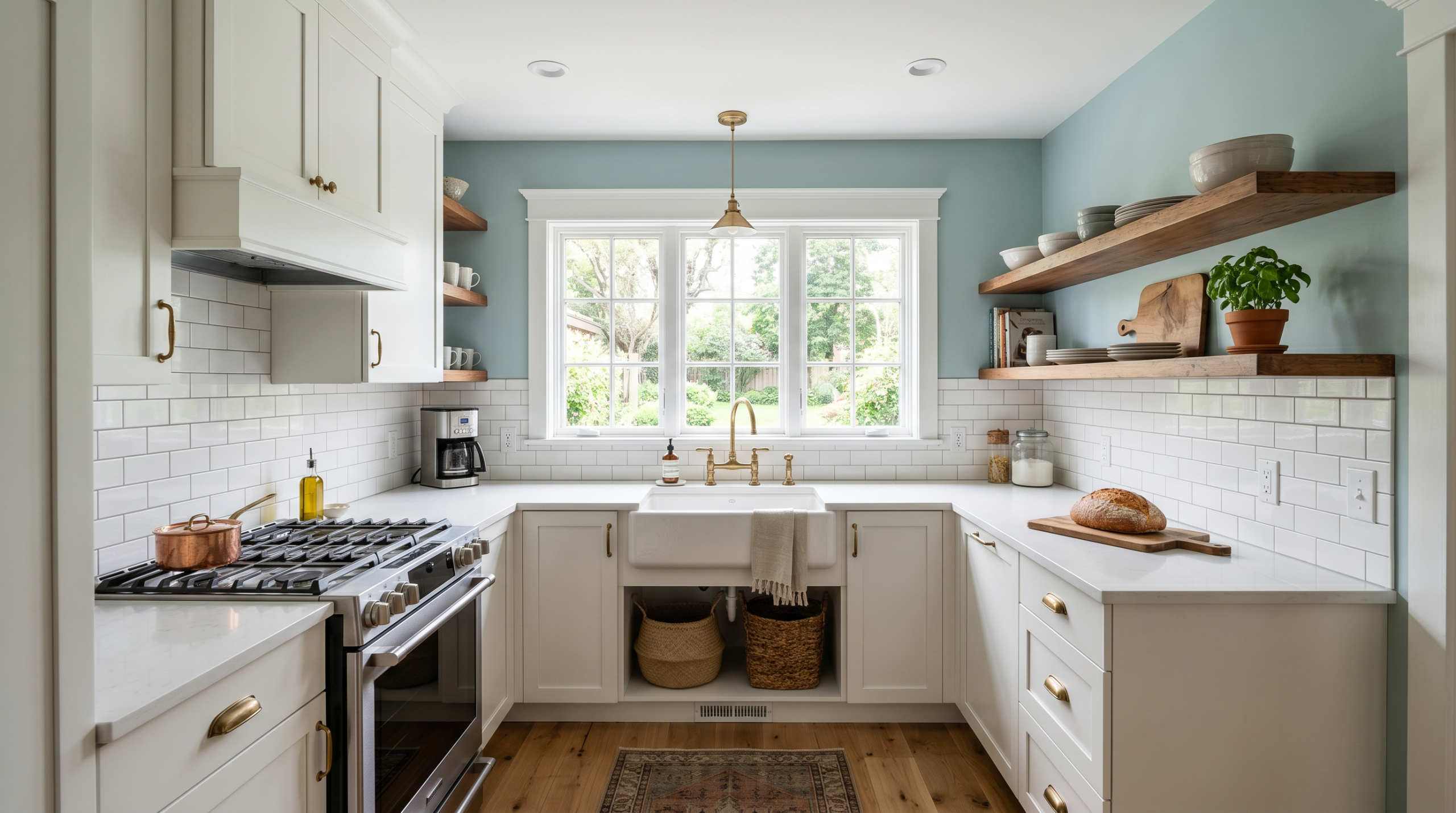
At LRV 60.4, Palladian Blue is the deepest wall-safe color on this list for a small kitchen. Homeowners on multiple painting forums report their rooms feeling “light and spacious” after applying it, even with limited window exposure. For the strongest effect, pair Palladian Blue walls with BM Chantilly Lace (OC-65) on cabinets and trim, since the high-contrast white offsets the lower wall LRV.
Sherwin-Williams Evergreen Fog (SW 9130)
Evergreen Fog is the exception on this list: at LRV 30, it absorbs significantly more light than every other pick. It works in small kitchens when used exclusively on lower cabinets in a two-tone layout with white uppers and white walls. Sherwin-Williams selected it as their 2022 Color of the Year, and this muted sage green pairs with SW Pure White (SW 7005) for a clean, contemporary look with more depth than an all-white scheme.
Paint Finish Guide by Surface
Most small kitchen paint ideas articles focus only on color and skip finish entirely, yet choosing the correct paint finish for each surface affects both durability and how much light the walls reflect.
| Surface | Recommended Finish | Why |
|---|---|---|
| Kitchen walls | Satin | Reflects more light than eggshell; resists grease and moisture; easy to wipe |
| Near sink and stove | Semi-gloss | Maximum moisture resistance; harder surface for heavy cleaning |
| Cabinets | Semi-gloss or high-gloss | Durability against daily contact; smooth surface for cleaning; subtle light reflection |
| Ceiling | Flat or matte | Hides imperfections; a slightly lighter shade adds perceived height |
For cabinet-specific paint, Benjamin Moore Advance (waterborne alkyd) and Sherwin-Williams Emerald Urethane Trim Enamel are the two products DIY painters and professional painters reference most for kitchen projects. Both level out to a smooth, furniture-like finish without requiring a professional spray setup. Before painting cabinets, sand all surfaces with 150-grit followed by 220-grit for a smooth base; our sandpaper grit chart covers the full selection process. If older cabinets have loose joints or separated door frames, repair them with wood glue suited to the joint type and clamp overnight before priming.
Monochromatic vs. Two-Tone Cabinet Strategy
One of the biggest decisions for cabinet paint colors for small kitchen layouts is whether to paint everything the same color or split the upper and lower cabinets into two tones. Consequently, each approach creates a different visual effect on perceived room size.
Monochromatic: Same Color Everywhere
Painting walls, cabinets, and trim the same high-LRV white (such as BM Chantilly Lace or SW Pure White) eliminates visual breaks between surfaces. As a result, the eye moves continuously through the space, making the room feel wider and taller. Although the monochromatic approach risks looking flat, using satin finish on walls and semi-gloss on cabinets creates enough textural contrast to add depth.
Two-Tone: Light Uppers with Deeper Lowers
A two-tone kitchen pairs white or off-white upper cabinets with a deeper tone on the lowers, such as SW Evergreen Fog on lower cabinets with SW Pure White on the uppers and walls. Because the eye naturally reads the lighter upper portion as open space, the room feels taller even when the lower half carries more visual weight. Similarly, this approach lets you add color personality without darkening the full kitchen. I used a similar strategy after living with my all-dark-red kitchen, and the lighter-on-top combination delivered both openness and the depth of a richer accent color.
Best Paint Colors for Small Kitchen Walls: Pros and Cons
Lighter paint colors for small kitchens offer clear advantages for tight spaces, alongside a few practical trade-offs worth considering before you commit.
Pros
- LRV 80+ whites reflect up to 90% of ambient light, maximizing brightness
- Monochromatic white schemes eliminate visual breaks, making walls appear farther apart
- Warm whites (White Dove, Alabaster) avoid a clinical feel while keeping LRV above 80
- Satin and semi-gloss finishes add both durability and extra light reflection on light colors
- Light neutrals like Pale Oak and Gray Owl add warmth without dropping below LRV 65
- Two-tone setups let you add color on lowers while keeping uppers and walls bright
Cons
- White and off-white kitchens show dirt, grease splatter, and scuff marks more readily
- Colors below LRV 65 need strong natural light; north-facing kitchens with few windows risk looking dim
- Monochromatic white schemes look flat without textural variety in finish (satin vs. semi-gloss)
- Some whites shift undertone under artificial lighting (warm LEDs push yellow; cool LEDs push blue)
- Trending colors like Evergreen Fog (LRV 30) need careful placement to avoid shrinking the room
Final Verdict
For most small kitchens, a warm white with an LRV above 80 is the single most effective color for creating a sense of spaciousness. Benjamin Moore White Dove (OC-17) and Sherwin-Williams Alabaster (SW 7008) are the two strongest all-around picks, because both deliver high light reflectance with enough warmth to feel inviting rather than sterile.
If white feels too safe, colors in the LRV 60 to 70 range like SW Sea Salt or BM Palladian Blue bring noticeable color to the walls while still reflecting enough light to keep a small kitchen open. However, these work best in kitchens with at least one window providing direct sunlight for several hours daily.
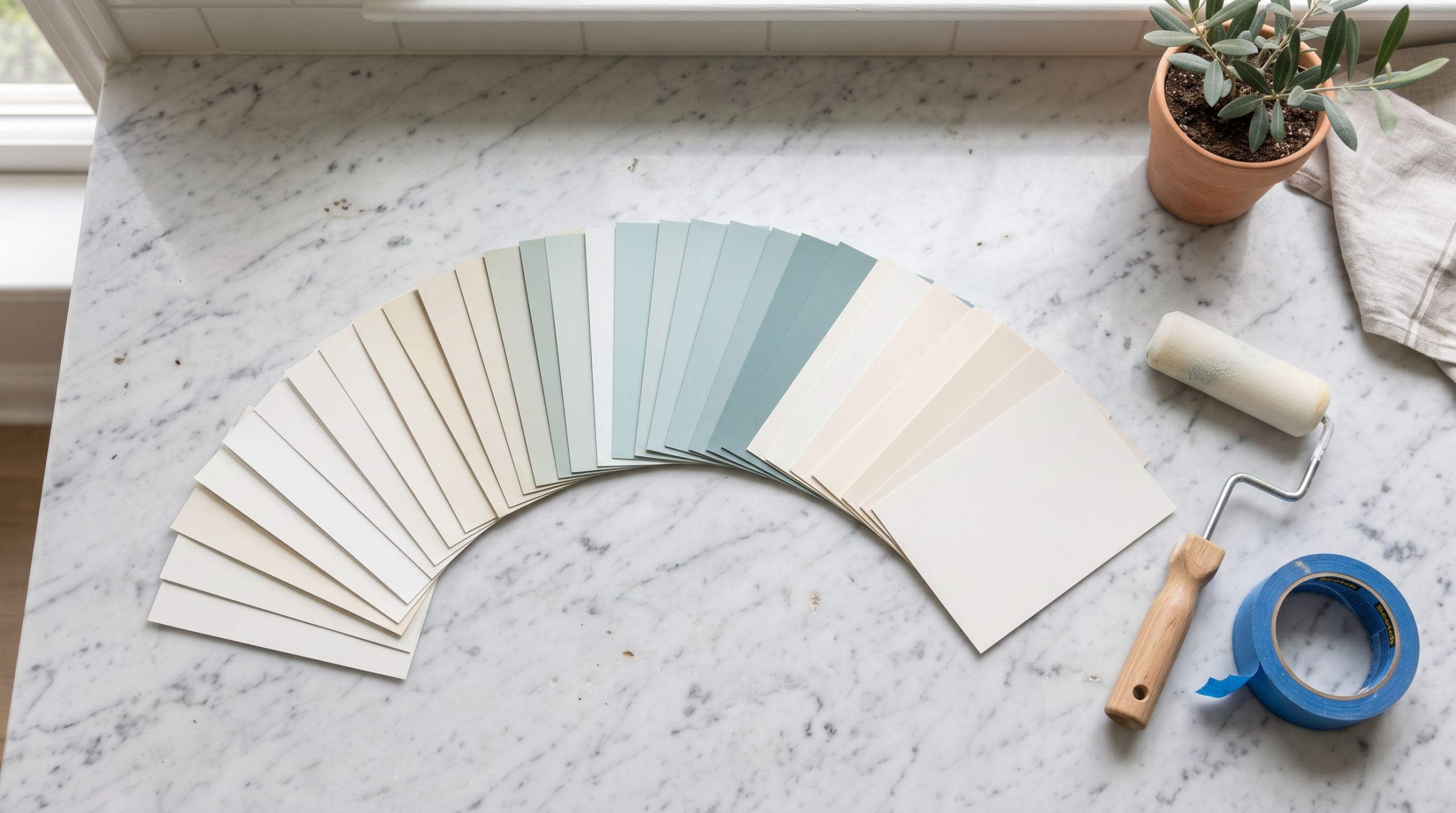
The best paint colors for small kitchen projects also depend on finish selection. Satin on walls and semi-gloss on cabinets is the combination offering both durability and additional light bounce. Before starting, order peel-and-stick samples from Benjamin Moore or Sherwin-Williams and test them in your kitchen at different times of day, since undertones shift between morning and evening light.
After repainting four kitchens, the pattern is clear: every lighter shade made the room feel larger the morning after it dried. My soft blue kitchen felt twice as open as its predecessor, and the warm white cabinets I installed later amplified the effect even further. Start with the proven high-LRV picks in this guide, and your small kitchen will feel noticeably larger without a single structural change.
Frequently Asked Questions
What color makes a small kitchen look bigger?
Warm whites with an LRV of 80 or higher, like BM White Dove (OC-17, LRV 83) and SW Alabaster (SW 7008, LRV 82), work best on small kitchen walls because they reflect the most ambient light. These shades make surfaces appear to recede, creating a stronger sense of depth. In addition, soft blue-greens like BM Palladian Blue (LRV 60) and SW Sea Salt (LRV 63) add color while still keeping the space airy.
Should I paint my small kitchen white?
White is the most reliable choice for expanding perceived space, yet warm whites outperform cool or blue-toned whites in kitchens. Specifically, whites with subtle yellow or cream undertones (like Simply White OC-117 or Alabaster SW 7008) feel inviting instead of cold. Avoid harsh cool whites in small kitchens, since they tend to feel institutional under fluorescent or cool LED lighting.
What paint finish is best for kitchen walls?
Satin is the recommended finish for kitchen walls because it reflects more light than eggshell and resists grease and moisture. For areas directly around the sink and stove, semi-gloss provides even stronger moisture resistance. On cabinets, semi-gloss or high-gloss delivers the best durability for daily contact and cleaning.
What is LRV in paint, and why does it matter?
LRV stands for Light Reflectance Value, a metric measuring how much light a color reflects on a scale from 0 (pure black) to 100 (pure white). For small kitchens, specifically aim for wall colors with an LRV of 70 or higher and cabinet colors at LRV 80 or higher. Because higher LRV means more light bouncing around the room, it directly increases perceived size.
Does dark paint make a small kitchen look smaller?
Generally, yes. Dark colors absorb light and make surfaces appear closer, reducing perceived space. However, a two-tone approach using dark paint only on lower cabinets (such as SW Evergreen Fog at LRV 30) while keeping walls and uppers white preserves an open feel above eye level. The key is limiting dark tones to surfaces below the counter line.
What are the best cabinet paint colors for small kitchen layouts?
High-LRV whites like White Dove (OC-17, LRV 83) or Alabaster (SW 7008, LRV 82) are the strongest cabinet paint colors for small kitchen spaces because they maximize light reflection on the surfaces closest to eye level. For a two-tone approach, pair white uppers with a deeper lower cabinet shade like Evergreen Fog (SW 9130) to add depth. In either case, use semi-gloss or high-gloss finish on cabinets for durability and additional light bounce.
Leave a Reply