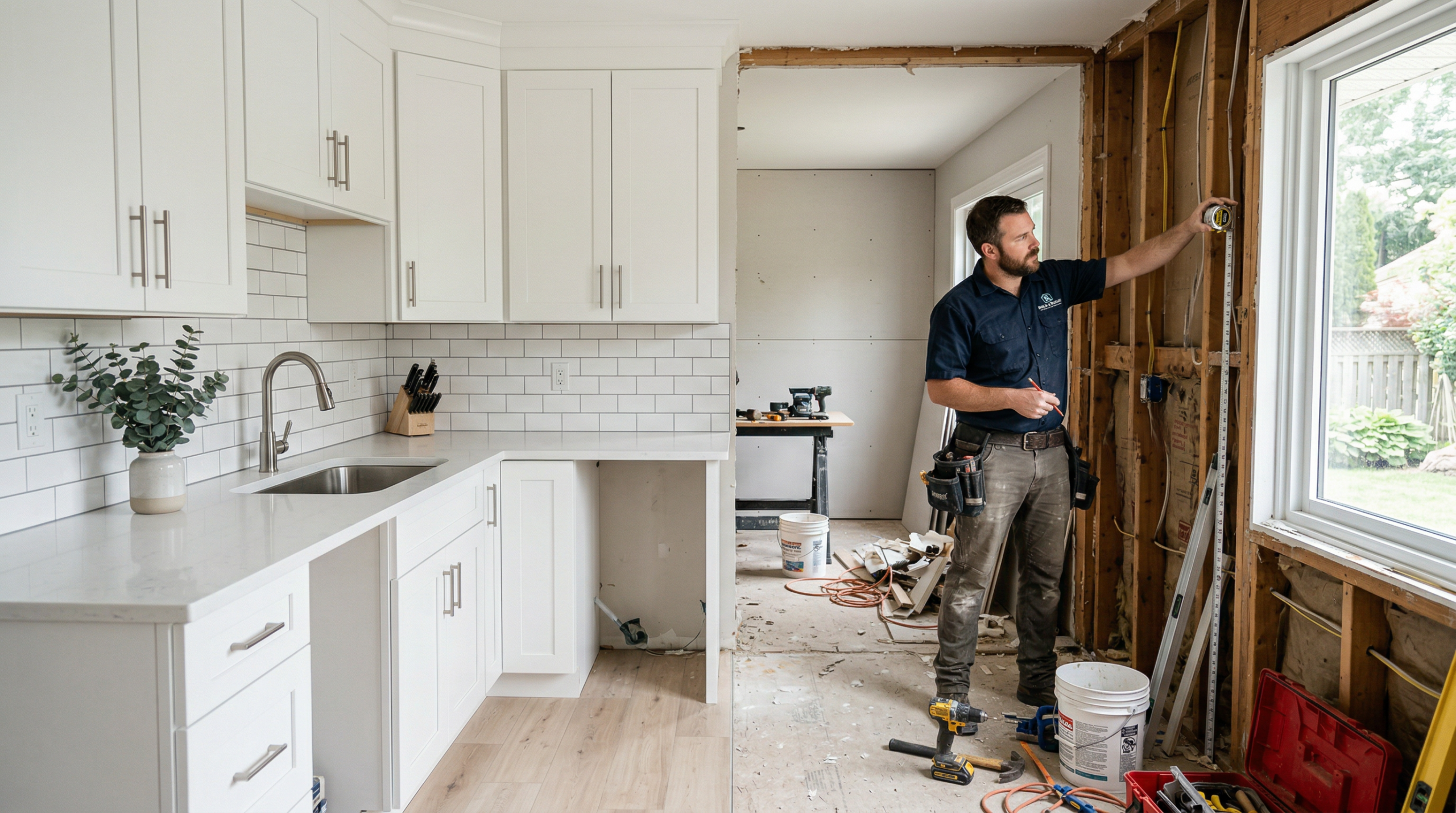
Quick Verdict: The kitchen remodel cost 2026 national average sits at $26,962. Most projects run between $14,585 and $41,534 according to Angi’s 2026 data. Minor cosmetic refreshes start around $10,000 to $20,000 and deliver the strongest ROI at 112.9% per the 2025 Zonda Cost vs. Value report. Full gut renovations with custom cabinets and layout changes regularly exceed $130,000. Cabinets consume 30% to 40% of your total budget regardless of scope. That makes them the single most important cost decision in any kitchen project.
Additionally, last updated: April 2026 | 12 min read
In This Article
- Kitchen Remodel Cost 2026: What Moves Your Number
- Key Cost Facts at a Glance
- Cost Breakdown by Component
- Budget vs. Mid-Range vs. Upscale: The Three Tiers Explained
- Hidden Costs Most Homeowners Miss
- How to Save Money on a Kitchen Remodel
- Kitchen Remodel ROI and Resale Value
- Pros and Cons of Kitchen Renovation
- Final Verdict
- Frequently Asked Questions
Kitchen Remodel Cost 2026: What Moves Your Number
Moreover, planning around kitchen remodel cost 2026 means understanding what sets your specific number. In addition, the national average tells you almost nothing useful on its own. Besides, most homeowners anchor to a single figure and build a project around it. However, they run short when the real scope becomes clear. On the other hand, the factors that move cost by 40% or more include kitchen size, layout changes. Conversely, the condition of existing plumbing and electrical, and your location.
Budget Tiers and National Averages
Still, after 30 years of renovating kitchens, I’ve seen every budget scenario play out. Therefore, that includes seven years building custom timber frame homes in upstate New York. As a result, new construction kitchens start with square walls, fresh rough-in, and current wiring. Consequently, a 1960s kitchen gut often reveals aluminum branch circuit wiring. For this reason, cast-iron drain lines at the end of their service life. Specifically, walls are frequently so far from plumb the cabinet installer needs shimming on every run. In particular, as a former remodeling electrician, I know firsthand: the electrical portion of a kitchen gut renovation runs higher than most homeowners expect. Notably, a service panel upgrade alone adds $1,500 to $4,000 before a single new circuit is run.
For example, according to Angi’s 2026 kitchen remodel data. Similarly, the national average is $26,962, with most homeowners landing between $14,585 and $41,534. Likewise, per-square-foot costs run $75 to $250 for standard projects. In contrast, scope determines where your project lands within those figures. Meanwhile, minor cosmetic updates run $10,000 to $20,000. Subsequently, mid-range full renovations span $20,000 to $65,000. Eventually, complete gut jobs with layout changes start at $65,000 and exceed $130,000 in most markets. Ultimately, understanding those tiers before you pick up the phone saves enormous time and prevents budget surprises once work begins.
Key Cost Facts at a Glance
| Cost Factor | Typical Range / Figure | Source |
|---|---|---|
| National average kitchen remodel cost | $26,962 (range: $14,585 – $41,534) | Angi, 2026 |
| Minor cosmetic remodel | $10,000 – $20,000 | Angi, 2026 |
| Mid-range full renovation | $20,000 – $65,000 | Angi, 2026 |
| Full gut / complete remodel | $65,000 – $130,000+ | Angi, 2026 |
| Cost per square foot (national) | $75 – $250 per sq ft | Angi / HomeAdvisor, 2025 |
| Minor remodel cost (Cost vs. Value benchmark) | $28,458 national median | Zonda Cost vs. Value, 2025 |
| Major midrange remodel (benchmark) | $82,793 | Zonda Cost vs. Value, 2025 |
| Upscale major remodel (benchmark) | $164,104 | Zonda Cost vs. Value, 2025 |
| Cabinets as share of total budget | 30% – 40% | Angi, 2026 |
| Labor as share of total budget | 20% – 35% | Multiple sources |
| Minor remodel ROI | 112.9% | Zonda Cost vs. Value, 2025 |
| Major midrange remodel ROI | ~50.9% | Zonda Cost vs. Value, 2025 |
| Typical project timeline | 6 – 12 weeks construction; 3 – 6 months total | Multiple contractors, 2025 |
| Recommended contingency buffer | 15% – 20% above base estimate | Industry standard |
Cost Breakdown by Component
Overall, knowing where every dollar goes prevents the most common budget shock: discovering mid-project that a single component line has eaten 50% of your budget. Additionally, cabinets, countertops, labor, flooring, appliances, plumbing. Moreover, electrical each carry distinct cost ranges, and each rewards different levels of investment depending on your project scope.
Cabinets: 30%–40% of Total Budget
In addition, cabinets are the largest single expense in any kitchen remodel. Besides, consistently consuming 30% to 40% of total project cost according to Angi’s 2026 data. However, on a $35,000 mid-range renovation, the cabinetry share runs $10,500 to $14,000. On the other hand, stock cabinets in standard box sizes cost $100 to $300 per linear foot installed. Conversely, semi-custom options, which offer more finish choices and better construction, run $155 to $500 per linear foot. Still, full custom cabinetry starts at $500 per linear foot. Therefore, it climbs past $1,200 for premium hardwoods with dovetail joints and soft-close drawer hardware throughout.
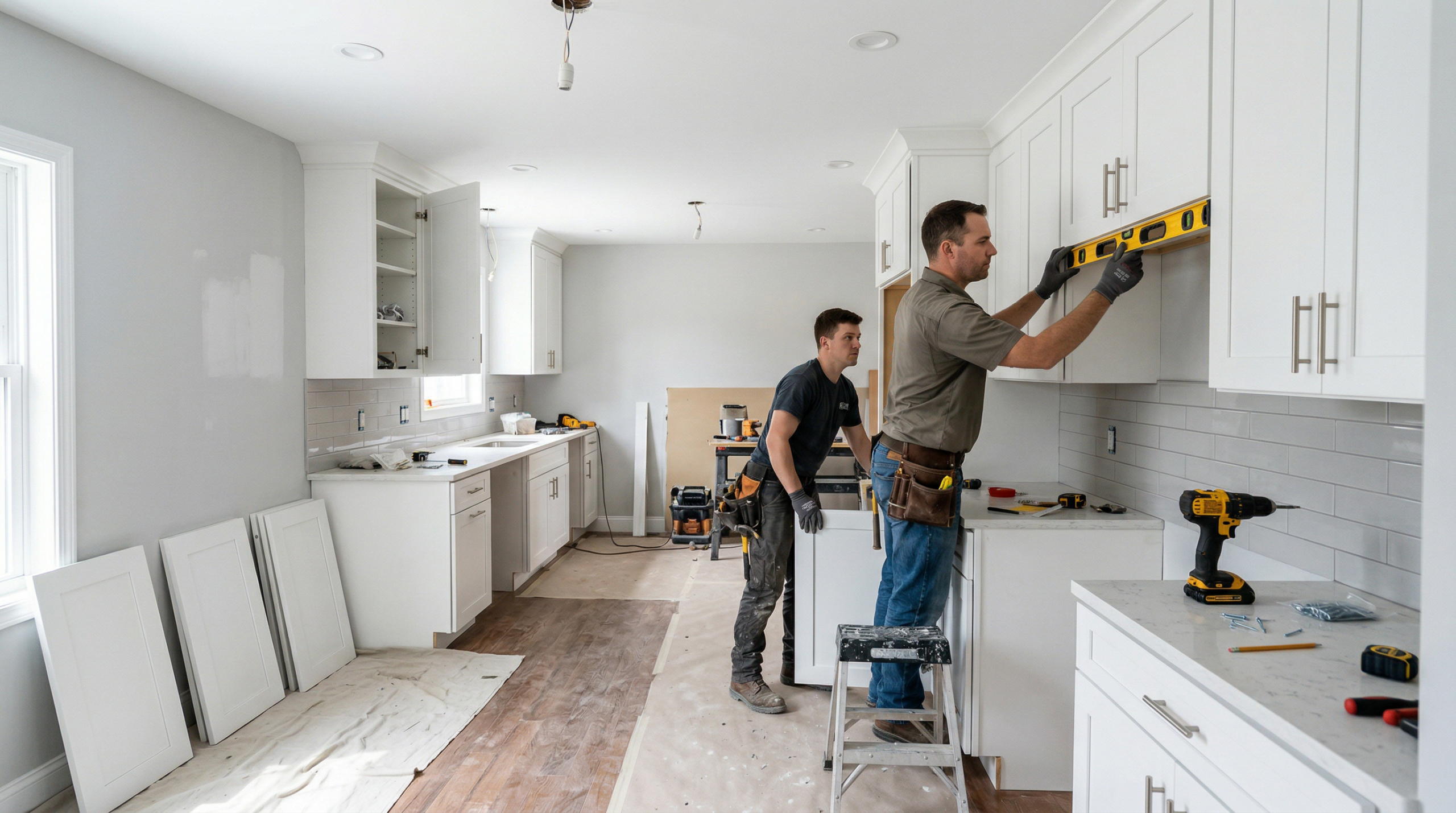
As a result, i consistently steer mid-range clients toward semi-custom cabinets. Consequently, this comes from 30 years of finish carpentry work. For this reason, a precision woodworking background built rebuilding Pitts Special biplanes in college. Specifically, the box quality exceeds stock by a meaningful margin. In particular, the face frame and door finish options are substantially broader. Notably, the cost gap versus full custom is typically $200 to $700 per linear foot. For example, for most homeowners, semi-custom delivers the right combination of quality and value.
Countertops: 10%–15% of Total Budget
Similarly, countertop costs vary more by material than by any other single variable. Likewise, laminate remains the most affordable option at $8 to $35 per square foot for materials alone. In contrast, quartz, the dominant mid-range choice, runs $15 to $70 per square foot for materials. Meanwhile, $40 to $100 per square foot installed. Subsequently, granite ranges from $10 to $140 per square foot for materials depending on slab grade, color, and edge profile. Eventually, marble and premium engineered stones push $15 to $190 per square foot for materials. Ultimately, according to Angi. Overall, the typical installed countertop cost for a kitchen ranges from $1,800 to $4,400, with complex layouts or premium materials reaching $10,000 or more.

Labor: 20%–35% of Total Budget
Additionally, labor is the second-largest expense after cabinets, averaging 20% to 35% of total project cost on standard renovations. Moreover, for every $10,000 you plan to spend on a kitchen. In addition, angi’s data indicates budgeting approximately $2,500 in labor costs. Besides, electricians bill $50 to $100 per hour nationally. However, though high-cost metros push rates 40% to 60% above the national baseline. On the other hand, plumbers run $45 to $200 per hour depending on region and complexity. Conversely, general contractor overhead adds 10% to 20% on top of subcontractor labor. Still, complex structural projects — those involving load-bearing wall removal or layout changes — push labor toward 40% to 50% of total cost. Therefore, multiple trades must be on-site simultaneously.
Flooring: 5%–10% of Total Budget
As a result, kitchen flooring typically runs $1,000 to $5,000 for a standard-size kitchen. Consequently, per Angi’s cost data. For this reason, luxury vinyl plank (LVP) offers the best combination of value. Specifically, moisture resistance at $3 to $7 per square foot for materials. In particular, ceramic tile runs $4 to $40 per square foot for materials. Notably, with installation labor adding $7 to $15 per square foot on top. For example, hardwood flooring costs $6 to $22 per square foot for materials and $3 to $8 per square foot for installation. For a deeper look at how LVP compares to other flooring options. The laminate vs. vinyl plank flooring comparison covers the durability, cost, and installation tradeoffs in detail.
Appliances: 15%–20% of Total Budget
Appliance packages for a mid-range kitchen, covering refrigerator, range, microwave. Dishwasher, run $2,100 to $5,400 for mid-tier brands. Individual appliance costs vary widely: refrigerators run $1,000 to $4,000. Ranges $800 to $3,500, dishwashers $500 to $1,500. Range hoods $300 to $1,200. According to Angi, individual appliance installation adds $125 to $300 per unit on top of the appliance cost itself. Professional-grade appliances from brands like Viking or Sub-Zero push well past these figures. With single refrigerators exceeding $10,000 in luxury configurations.
Plumbing: 5%–8% of Total Budget
Plumbing costs stay modest when the layout doesn’t change. A faucet replacement costs an average of $260 to install. A new sink installation averages $420, per Angi’s data. Adding new pipes or repiping a kitchen section costs $1,500 to $15,000 depending on extent. With an average of $7,500. Moving a gas line adds $375 to $750 per line relocation. The real cost driver is layout changes. Moving the sink to a kitchen island requires new supply lines, drain rough-in, and subfloor patching. That commonly adds $2,000 to $5,000 in plumbing work alone.
Electrical: 3%–7% of Total Budget
Electrical work runs $1,000 to $4,000 on a standard kitchen remodel. As a former remodeling electrician, I know this portion surprises homeowners most consistently. A service panel upgrade — which older homes frequently need to support modern appliance loads — costs $1,500 to $4,000 before any new circuits are run. New outlets run $100 to $450 each installed. Under-cabinet lighting adds $230 to $300 per linear run. In homes built before 1985, aluminum branch circuit wiring requires evaluation. It often needs replacement or remediation before new circuits connect safely. For the common electrical mistakes tripping up kitchen renovations. The electrician’s perspective matters more than most homeowners realize before demo starts.
Budget vs. Mid-Range vs. Upscale: The Three Tiers Explained
Kitchen renovation costs separate into three fundamentally different project types. Choosing the wrong tier for your goals is the source of most budget regret. Each tier represents a different approach to the work, not merely a different spending level for the same project.
Budget Remodel: $10,000–$25,000
A budget kitchen remodel keeps the existing layout intact and targets cosmetic improvements. Typical work includes painting or refacing cabinet doors. Drawer fronts, replacing countertops, installing a new backsplash, swapping hardware, and updating lighting fixtures. Replacing one or two appliances is also common. Because none of these tasks require opening walls, moving plumbing, or pulling new electrical, labor costs remain manageable. This tier works best for kitchens where the cabinet boxes are structurally sound and the layout functions well. The primary goal is visual refresh rather than functional overhaul. According to the 2025 Zonda Cost vs. Value report, this scope produces a 112.9% national ROI. The highest of any interior remodel tracked in the report.
Mid-Range Remodel: $25,000–$65,000
Mid-range renovations replace most kitchen elements while preserving the existing layout. New semi-custom cabinets, stone countertops (typically quartz or granite), updated flooring. A full appliance package all fall within this tier. Refreshed plumbing fixtures are also standard at this scope. Since plumbing and electrical remain in their original positions, trade costs add relatively little compared to a gut job. For a 10×10 kitchen at 100 square feet. This scope runs $18,000 to $50,000 nationally per Angi’s 2026 data. Homeowners staying in the property for five or more years get both quality-of-life improvement. A strong resale position from this tier.
Upscale Remodel: $65,000–$200,000+
Upscale kitchen renovations involve full gut work and custom cabinetry. They also typically include layout changes and structural modifications like load-bearing wall removal or kitchen expansion. The 2025 Zonda Cost vs. Value benchmark puts a major midrange remodel at $82,793 and a full upscale project at $164,104. In high-cost metro markets like Northern California, the Washington D.C. area, and coastal New York, even mid-range gut jobs regularly reach $100,000 to $150,000. Labor rates and permitting complexity drive those figures. Moving plumbing, removing load-bearing walls, and adding structural elements each require permits, inspections, and licensed tradespeople. Rates run 40% to 60% above the national baseline in those markets.
Hidden Costs Most Homeowners Miss
Hazardous Materials and Mold
Every kitchen renovation produces discoveries after demolition starts. The experienced approach is to budget for them before signing a contract. Change-order pricing gives contractors maximum leverage once work is underway.
In homes built before 1980, asbestos-containing materials — in floor tiles, pipe insulation. Joint compound — require professional testing before mechanical demolition begins. Testing runs $200 to $800 for a standard kitchen. Abatement, when materials test positive, adds $500 to $3,000 depending on the extent. Mold remediation inside walls costs $1,500 to $5,000 when water damage or condensation has allowed growth behind cabinets or under the sink. Neither discovery shows up in an initial contractor quote — because neither is visible before demo.
Subfloor Damage and Permit Fees
Subfloor condition is the second most common surprise. Old vinyl flooring and tile frequently trap moisture, and the subfloor beneath deteriorates silently for years. Subfloor repairs on a standard kitchen run $500 to $2,500 depending on the extent of damage. In severe cases — particularly in ground-floor kitchens over crawl spaces in humid climates — full subfloor replacement adds $2,000 to $6,000. Permit fees for kitchen work also catch homeowners off guard. Building, electrical, and plumbing permits combined typically run $460 to $2,770 per Angi’s data. And structural changes push fees higher.
Contingency Budget and Temporary Storage
Storage costs during the remodel deserve a line item too. A portable storage unit runs $90 to $250 per month, and moving large appliances costs $100 to $300 per piece. For a project running 10 to 12 weeks, temporary storage adds $500 to $1,500 to the total. The practical approach is to add 15% to 20% above your base contractor quote as a contingency line item before any contract is signed. On a $35,000 remodel, hold $5,250 to $7,000 in reserve specifically for post-demo discoveries. This is standard practice for experienced remodelers, not excessive caution.
How to Save Money on a Kitchen Remodel
Keep the Layout Intact
Meaningful cost savings come from strategic decisions made before the project starts. They don’t come from shopping for the cheapest contractor after bids come in. Contractors with the lowest initial bid frequently recover margin through change orders once work begins. The better approach is to reduce scope intelligently and contribute labor on tasks homeowners handle safely.
Keeping the existing layout is the single highest-impact cost decision you make. Moving the sink to the opposite wall requires pulling up flooring and running new supply and drain lines. It also requires patching the subfloor and ceiling below. The combined cost of a single sink relocation runs $2,000 to $8,000 depending on the plumbing path and finished materials. Avoiding layout changes on a mid-range project saves the entire sum. It has no visible impact on the finished kitchen’s appearance.
Make Smart Cabinet and Material Choices
Within your component budget, the cabinet decision rewards careful calibration. Stock cabinets at $100 to $300 per linear foot installed represent real savings versus semi-custom. In a kitchen where the box quality is adequate for the intended use, they function correctly for decades. Cabinet hardware, however, upgrades cheaply at any time after installation at $1 to $5 per piece for quality pulls and knobs. Prioritizing box quality over door style is a better trade than the reverse. Similarly, choosing materials. Finishes built for long-term durability prevents the more expensive decision of replacing prematurely worn surfaces five years post-remodel.
Take On DIY Tasks Strategically
DIY contributions reduce cost on the right tasks. Demolition — removing old cabinets, pulling flooring. Stripping tile — adds $1,500 to $3,000 in labor when a contractor handles it. A homeowner with basic tools and time covers most kitchen demolition safely over a long weekend. Painting cabinets instead of replacing them saves $3,000 to $15,000 when the existing boxes are structurally sound. Proper surface preparation and a quality oil-based primer are non-negotiable for a durable result. For paint selection on cabinets and trim, the best interior paint brands comparison covers adhesion, hardness. Coverage characteristics relevant to kitchen cabinet applications.
Kitchen Remodel ROI and Resale Value
Return on investment from a kitchen remodel is highly scope-dependent. The data is consistent across multiple years: smaller, targeted renovations outperform large-scale rebuilds at resale. The 2025 Zonda Cost vs. Value report — the industry’s most authoritative annual benchmark — shows minor midrange kitchen remodeling delivered a 112.9% national ROI. This returns more than the original investment in home value. A $28,458 minor remodel added roughly $32,130 to resale value on average.
Major midrange remodels returned approximately 50.9% in the same report. Specifically, a $82,793 renovation added about $42,130 to home value. Upscale major renovations returned around 35.7%, with a $164,104 project adding roughly $58,580 in resale value. The gap between what you spend and what you recover at resale widens significantly as scope increases. Homeowners planning to stay in their home for 10 or more years, however, often find the daily-use value. Quality-of-life improvement justify the lower financial return.
Most financial advisors recommend keeping total kitchen renovation spending at or below 15% of the home’s current market value. On a $350,000 home, the upper limit works out to $52,500. Exceeding this threshold — particularly in slower real estate markets — risks over-improving beyond what comparable homes in the neighborhood support. According to Angi’s general ROI guidance. Kitchen remodels as a whole return approximately 70% to 80% of cost at resale on average across all scopes. The 112.9% figure applies specifically to minor midrange projects. It reflects the outsized value buyers place on kitchen condition relative to renovation cost.
Pros and Cons of Kitchen Renovation
Pros
- Minor remodels return 112.9% of cost at resale (Zonda Cost vs. Value, 2025)
- Increases home value by 70% to 80% of project cost on average across all scopes
- Improves daily functionality with better layout, storage, and work surface
- Energy-efficient appliances reduce utility costs; ENERGY STAR dishwashers use 3.2 gallons per cycle vs. 9 to 14 gallons for pre-1994 models (EPA)
- Modernized kitchen accelerates home sale and attracts stronger offers
- Budget remodels ($10,000 – $20,000) deliver high ROI with manageable disruption
- DIY contributions on demolition and painting reduce labor cost by $1,500 to $15,000
Cons
- Kitchen is the room most likely to exceed budget; 31% of homeowners with a set budget go over it (Houzz 2020 U.S. study)
- Full gut renovations return only 35.7% of cost at resale on the upscale tier
- Project timelines run 6 to 12 weeks of construction, with full timelines of 3 to 6 months including planning and lead times
- Hidden costs average $1,500 to $10,000+ in pre-1980 homes after demo
- Layout changes requiring plumbing moves add $2,000 to $8,000 per fixture
- Kitchen is unusable during construction, requiring temporary meal arrangements
Final Verdict on Kitchen Remodel Cost 2026
What Drives Your Actual Number
The kitchen remodel cost 2026 national average of $26,962 describes the statistical middle of a wide distribution. It does not describe any specific project. Your actual cost depends on scope, materials, the condition of your existing kitchen structure, and your location. A minor cosmetic update in the Midwest runs $10,000 to $20,000 and delivers 112.9% ROI. The same scope in coastal California runs $40,000 to $75,000. Labor rates and permitting costs reduce the financial return in those markets.
Near-Term Sale vs. Long-Term Ownership
For homeowners with a near-term sale in mind. The financial case for a minor remodel is strong and well-supported by data. Updating what buyers see directly — specifically cabinets, countertops, and appliances — without touching the layout or structure keeps costs manageable. Resale return then exceeds project cost. Avoiding layout changes alone saves $5,000 to $20,000 in plumbing and electrical rework. There is no visible impact on the finished kitchen’s appearance.
For homeowners staying for a decade or more, a mid-range renovation at $30,000 to $65,000 produces a kitchen that functions well. Holds its quality long-term. Spend on semi-custom cabinetry over stock when the box quality matters to you. Choose quartz or granite countertops over laminate for surfaces you touch every day. Buy appliances matching your cooking habits rather than the highest specifications on the floor. After 30 years of building and finishing kitchens from the studs up, the projects aging best share a common trait. The homeowner made durable mid-range choices rather than stretching budget materials to cover an upscale scope.
Build in a 15% to 20% contingency above your base quote before signing anything. Get every permit the scope requires. Before finalizing any layout change involving plumbing or load-bearing walls, get a structural assessment. A plumber’s rough-in estimate. Those two steps prevent the budget emergencies that turn $50,000 kitchens into $80,000 ones.
Frequently Asked Questions
How much does a kitchen remodel cost in 2026?
The national average kitchen remodel cost in 2026 is $26,962. Most projects run between $14,585 and $41,534 according to Angi’s 2026 data. Minor cosmetic updates cost $10,000 to $20,000. Mid-range renovations with new cabinets, countertops, and appliances run $20,000 to $65,000. Full gut renovations with layout changes, custom cabinetry. Structural work start at $65,000 and regularly exceed $130,000 in most U.S. markets. Location, scope, and material choices each shift your final number by 30% to 40% or more.
What is the most expensive part of a kitchen remodel?
Cabinets consistently claim the largest share of any kitchen remodel budget — typically 30% to 40% of total project cost per Angi. On a $35,000 mid-range remodel, cabinetry runs $10,500 to $14,000. Stock cabinets start at $100 to $300 per linear foot installed. Semi-custom options run $155 to $500 per linear foot. Full custom cabinetry starts at $500 per linear foot. Labor is the second-largest expense at 20% to 35% of total cost. Cabinets and labor together account for roughly half to three-quarters of most kitchen renovation budgets.
What kitchen remodel scope gives the best return on investment?
Minor midrange kitchen remodels delivered a 112.9% national ROI in the 2025 Zonda Cost vs. Value report, the highest return of any interior home improvement tracked in the report for the second consecutive year. This scope covers cosmetic updates including cabinet refacing, new countertops, appliance upgrades, and flooring replacement without changing the layout. Major midrange remodels returned approximately 50.9% in the same report, and upscale major renovations returned around 35.7%. The consistent pattern across multiple years of data: targeted cosmetic updates outperform large-scale rebuilds at resale.
How long does a kitchen remodel take?
Construction on a minor to mid-range kitchen remodel typically runs 6 to 12 weeks from demo to final walkthrough. The full project timeline — including design, permitting, material ordering, and construction — spans 3 to 6 months for a standard renovation. Custom cabinets alone carry 8 to 16 weeks of lead time in most markets. Full gut renovations with structural changes and custom everything extend to 5 to 8 months total. Delayed decision-making during the design phase is the most common timeline extender. It pushes back material orders and contractor scheduling.
What hidden costs should I budget for in a kitchen remodel?
The most common hidden costs after demo include subfloor repairs ($500 to $2,500), mold remediation inside walls ($1,500 to $5,000). Asbestos testing and abatement in pre-1980 homes ($200 to $3,000). Electrical panel upgrades when existing service is insufficient for new appliance loads add $1,500 to $4,000. Building permits for kitchen work add $460 to $2,770 nationally according to Angi. Moving any plumbing fixture adds $1,000 to $5,000 per fixture in new rough-in costs. Add 15% to 20% above the base quote as a dedicated contingency before any contract is signed. This is standard industry practice.
How much of my home’s value should I spend on a kitchen remodel?
Most financial advisors recommend limiting kitchen renovation spending to 15% of your home’s current market value. On a $350,000 home, the ceiling works out to $52,500. On a $600,000 home, the ceiling is $90,000. Exceeding this threshold risks over-improving beyond what comparable homes in your market support. It also limits your ability to recover the investment at resale. This guideline applies most strictly to homeowners within five years of a sale. Long-term homeowners staying 10 or more years have more flexibility because daily-use value compounds over time regardless of resale return.

Leave a Reply